Digital marketing has been declared “dead” many times over the past decade. Every major change, from social media saturation to rising ad costs and algorithm updates, has triggered doubts about its relevance. In 2026, the conversation has intensified because of artificial intelligence, automation, and the growing number of tools that promise instant results. Many business owners, professionals, and learners are now asking a valid question: is digital marketing still worth it?
The short answer is yes, but the longer and more honest answer depends on how digital marketing is understood and practiced today. Digital marketing in 2026 is not the same as it was a few years ago, and those who still follow outdated approaches are often the ones who feel disappointed.
Why This Question Matters More Than Ever
The concern around digital marketing today comes from three major shifts. First, AI tools can now generate content, ads, emails, and even websites in minutes, creating fear that human marketers are no longer needed. Second, platforms like Google and social media networks rely heavily on machine learning, making algorithms feel unpredictable. Third, the market appears crowded, with countless agencies, freelancers, and trainers offering similar services.
These changes create confusion, but they do not reduce the importance of digital marketing. Instead, they raise the bar for how it should be done.
What Digital Marketing Really Means in 2026
Digital marketing is no longer about posting content regularly or running ads without a plan. It is about understanding audiences, intent, and decision-making behavior. Modern digital marketing focuses on connecting the right message with the right audience at the right time, supported by data and strategy.
In 2026, successful digital marketing is built on systems, not isolated actions. Businesses that treat digital marketing as a structured process rather than a set of tools continue to see strong results.
How AI Changed Digital Marketing Without Replacing It
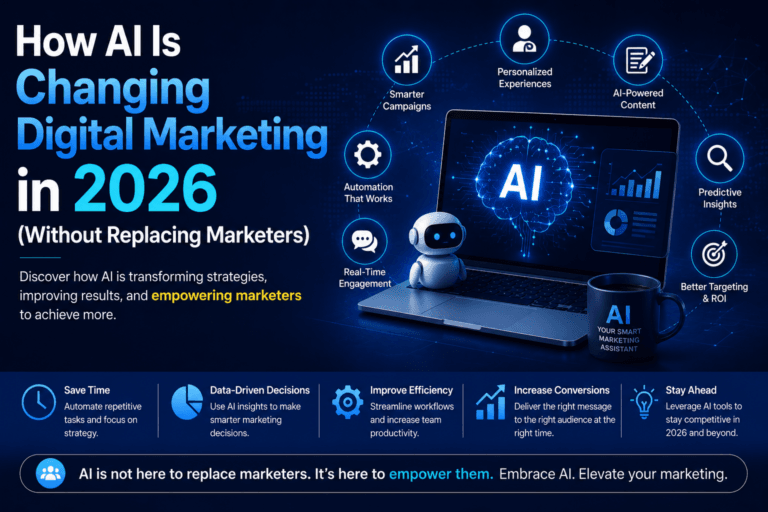
Artificial intelligence has transformed digital marketing, but it has not replaced marketers. AI has automated repetitive tasks such as keyword research, basic content drafting, ad copy variations, and reporting summaries. This has increased efficiency but also exposed weak strategies.
What AI cannot replace is business understanding, strategic thinking, ethical judgment, and creative decision-making. AI can assist execution, but it cannot decide what matters most for a specific business. In fact, AI has made strategy more important than ever.
Digital Marketing for Businesses in 2026
From a business perspective, digital marketing remains essential. Customers still research online before making decisions, compare options, read reviews, and look for trust signals. What has changed is the expectation of clarity and accountability.
Businesses no longer want vanity metrics like traffic alone. They want visibility that leads to inquiries, leads, and revenue. Digital marketing works best when it aligns with business goals rather than operating as a separate activity.
Is Digital Marketing Still a Good Career in 2026?
Digital marketing is still a strong career option, but the nature of roles has evolved. The demand for people who only know tools is declining, while the demand for professionals who understand strategy, data interpretation, and decision-making is increasing.
Skills that remain valuable include SEO fundamentals, paid advertising logic, analytics, content strategy, and communication. Skills that are losing value include platform dependency, template-based execution, and superficial certifications. Careers in digital marketing are shifting toward strategic contribution rather than task execution.
Freelancing and Consulting Opportunities
One of the biggest growth areas in digital marketing is consulting and advisory work. Businesses increasingly seek clarity, prioritization, and direction rather than just execution. Freelancers and consultants who can diagnose problems, recommend strategies, and guide teams are in high demand.
In 2026, digital marketing rewards experience, accountability, and the ability to simplify complex decisions. Consulting-focused marketers often build longer-term relationships and more sustainable careers.
Common Myths About Digital Marketing in 2026
One common myth is that AI will replace marketers. In reality, AI replaces tasks, not judgment. Another myth is that the market is saturated. While low-skill services are crowded, strategic expertise is still scarce. A third myth is that only influencers succeed. Many successful digital marketers work behind the scenes within businesses and consulting roles.
Who Should Learn Digital Marketing Today
Digital marketing is still worth learning for business owners who want clarity and control, professionals looking to add strategic skills, freelancers seeking long-term relevance, and career switchers willing to invest in fundamentals. Learning digital marketing today requires patience, critical thinking, and continuous learning.
Who Should Avoid Digital Marketing
Digital marketing may not be suitable for those looking for shortcuts, instant income, or certificates without skill development. It also may not suit individuals who dislike data, analysis, and ongoing learning. The field rewards consistency and understanding, not quick wins.
Why SEO Still Matters in 2026
Despite AI-powered search features, SEO remains relevant because search intent still exists. People continue to look for answers, solutions, and services online. Modern SEO focuses on usefulness, authority, and intent rather than keyword repetition or volume-based publishing.
Businesses that treat SEO as a long-term asset rather than a quick tactic continue to benefit from organic visibility.
Paid Advertising Has Become More Strategic
Paid advertising has not become ineffective, but it has become less forgiving. Weak targeting, poor messaging, and weak landing pages fail quickly. Successful paid advertising in 2026 requires strong alignment between audience, message, and conversion path, supported by clear tracking and analysis.
Content Marketing Has Shifted From Volume to Value
AI has made content creation easy, but it has also made generic content invisible. Effective content marketing now focuses on solving specific problems, demonstrating experience, and providing clarity. Businesses that invest in useful and well-structured content continue to build trust and authority.
Analytics and Interpretation Are the Real Skills
Most businesses have access to analytics tools, but many struggle to interpret data correctly. Understanding what metrics matter and how to act on them is more valuable than collecting data alone. In 2026, insight and interpretation are core digital marketing skills.
Final Verdict: Is Digital Marketing Still Worth It in 2026?
Digital marketing is still worth it in 2026 for those who approach it seriously. It is no longer about tools, hacks, or trends. It is about understanding audiences, building systems, measuring outcomes, and making informed decisions.
For businesses, digital marketing remains essential. For careers, it offers long-term relevance. For consultants and strategists, it presents growing opportunities to help businesses navigate complexity with clarity. Digital marketing did not disappear; it evolved.us euismod quis viverra. Mattis vulputate enim nulla aliquet porttitor. Lorem ipsum dolor sit amet consectetur adipiscing. Libero id faucibus nisl tincidunt eget nullam non. Libero nunc consequat interdum varius.